
Employment by lupus- my story

Last week I mentioned my having to make adjustments in my work life due to having lupus. Working while having lupus can be a challenge. For me and many lupus patients, physical, mental, and emotional stress can trigger flares.
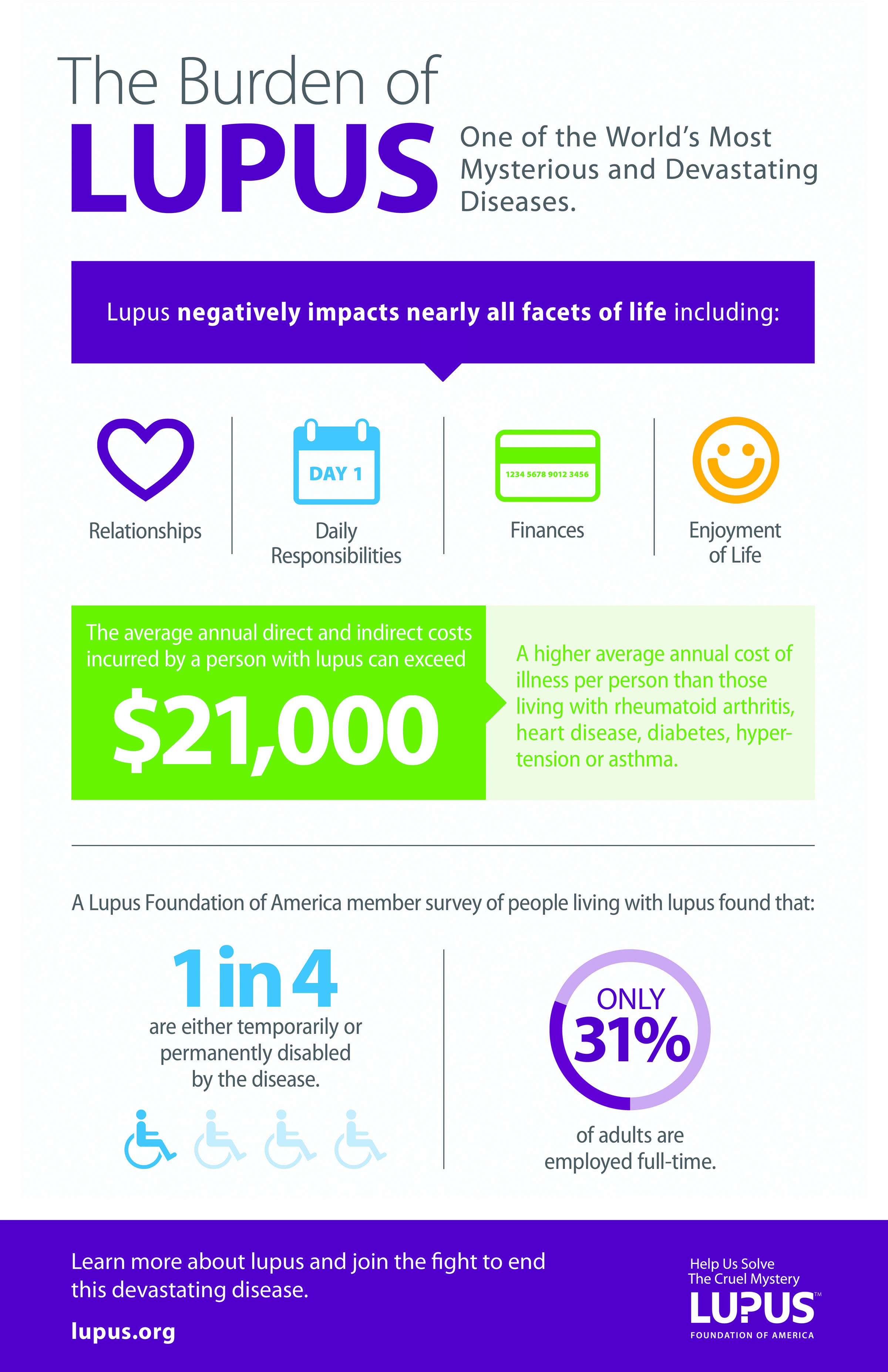
Infographic from the Lupus Foundation of America www.lupus.org
Infographic from the Lupus Foundation of America http://www.lupus.org

I began working in the ‘real world’ three years after my diagnosis. Through working campus jobs, I learned that I needed to spend less time on my feet, so I only look for desk jobs with minimal travel.

My first job was stressful, but I was able to work. It was a fast-paced, corporate job in NYC requiring long hours and some weekends. Not at all unusual for a job right out of college. I kept up with my doctor’s appointments and medications, but it seemed that the stress of the job caught up with me.

When I began to have flares, the joint pains I experienced in college were not the major issue, but rather fatigue was the new manifestation. This was fatigue that felt like I was chest high in thick mud trying to move. Lifting any part of my body was extremely difficult, and impossible on some days. My rheumatologist wrote letters to my employer to inform them that I needed to work from home most days of the week. That soon turned into working from home everyday, and eventually not working at all.

Getting ever more familiar with lupus and my body from these experiences, and speaking with my doctor, I knew I needed to take care of myself and change what I could to keep healthy.

Through this post, I thought I’d share my thoughts/tips on how to deal with having lupus and facing the difficulties that tend to come up around employment.

magnifying glass

  • Get health insurance!

You can’t manage lupus properly without having access to medical care. While I am all for natural remedies, make sure you are working within the medical healthcare system as well and letting your doctors know ALL of the medicines and supplements you are taking. You never know if there will be interactions. There is too much involved with lupus to play around with people who are not familiar with the disease or to not take medicines that can help you avoid major damage.

There are many ways to get health coverage now even if you don’t have a job or make much money:

  • Employer-based private insurance programs
  • Other group policies: When I was in between jobs, I joined a freelancers union where I was able to get a similar insurance plan that I would have gotten as a salaried full-time employee. While it wasn’t the creme de la creme, it ensured that I was able to keep up with my doctor visits and medicines
  • Government programs: Read up on Affordable Care Act and Medicaid

Read about each plan and choose the best one for you. Based on your experience with lupus (everyone is different) you may need to consider how many specialists you need to see regularly, and the co-pay associated with these specialists. You may also consider a 90-day program for prescriptions if you have a lot of medicine that you need to take regularly. It may save you a little money. You may also consider costs of visits to an ER or hospital stays, lab tests and the like. It is a very complicated healthcare system, but the more you know and keep tabs on how you fare month to month and year to year, you’ll find that these annoyances will become a snap for you to tackle.

  • Determine how you will work with human resources, your bosses or employees

You are not required to disclose your disability status when you interview or while employed on the job. If they ask you before you are hired, there are ways to handle these illegal questions. There are anti-discrimination laws that protect you from not being hired or being fired due to disability. You may not trust the organisation you work for, or the people who work directly with you. I’ve had experiences on both sides where I’ve not disclosed my health issues and where I have disclosed. Again, everyone’s experience with lupus is different, but here are a few tips based on what I’ve experienced:

Trust your gut.

How do people treat each other in the office? Trust your feelings and seek out appropriate counseling to find out your best bets for surviving this culture.

That said, use your sick days if you have them!

No one needs to know why you are out sick. Consult your HR manual to find out how many sick days you have and when you may need to get a note. For example, if you are out for more than three days, you may need to get a doctor to confirm that you have been ill and under their care. Again, the note doesn’t have to say why you were ill.

Find an ally

If you feel that you can trust the people at work (and this includes your boss), consider letting them know, especially if absences become more frequent and affect your work productivity. Depending on the type of job you have or position, HR may need to become involved. Again, consult an outside source to make sure you are protected from any unlawful termination.

Take it easy
lgi01b201310201300Stress is a normal part of working. Whether it’s emotional, physical or mental, any kind of stress can cause your body to retaliate and lash out on YOU! Make sure that you do not bite off more than you can chew, or at least realise when you have before it throws you into a tailspin.

Take time away from your desk to do something nice for yourself and decompress. Sometimes it’s hard to get away, but even if you need a trip to the bathroom for a breather or if there is a conference room or lunch room you can sit in, a little separation from all the activity might be a good thing.

Don’t get involved in other people’s problems to the point you take on their problems as your own.

If you have relationships with your coworkers that turn into friendships, you may get wind of things that might make you stressed-out for them. Sure you should take care of your friends and be concerned about their welfare, but make sure that it’s not at the expense of your own health and well-being.

Practice stress-relief tactics.

Meditation or deep breathing can slow your heart rate and help your body escape the fight-or-flight response which could cause your body to begin its lupus attack. There are yoga and tai chi classes that might double your stress relief by providing gentle movement (if you have things like joint pains) as well as mental stress relief. Check locally to see what might work for you.

If you are a student

Your school may have resources for disabled students that you can take advantage of. For example, I registered with my school’s office of disability services to have class notes typed up or recorded for me in case I couldn’t write or type myself or was unable to attend class due to illness. Now…again, I was in college in the 90’s so not everyone had a laptop or phone so hand written notes were normal, and lectures were not available online. You may not need these services in the same capacity as I did, but you should still register and find out what your school might be able to make available to you. You may need extensions on assignments and they can help you arrange with the proper parties to get things done so that you graduate in as normal a time frame as possible.

Consider letting your professors know Less of a touchy situation than telling your boss, letting your teachers or professors know what’s happening with you might also be helpful. I didn’t tell a professor what was happening to me and, because of the medicines I was on, completely passed out in the front middle row. That was super embarrassing for me and completely unintentional. While students fall asleep in class all the time, at least they’d know that you weren’t sleeping because you were partying all night. I was very behind in his classes and ended up needing an extension to finish his class on time, so building a relationship might be a good way to keep up.

Here are some resources I looked up for more information on this topic:

Living with lupus and living with(out) limits

After my post last week I’ve been thinking about how I perceive my having lupus (and Sjogrens and Raynaud’s). I didn’t want to discourage people from realising their dreams as I spoke of never being able to play soccer again. But I’ve realised that it’s ok to be realistic, be creative and be positive. And dare I say, find a little humour in your gimpy-ness.

Through living with lupus for almost 20 years now, for the most part I feel road-sign-63983_1280content with my abilities and disabilities. I’ve mostly accepted that some things are not for me. It’s a constant process figuring out “what I can do” “what I can’t do” and “what I shouldn’t do”.

This was very, very hard in the beginning. It was new, I was adjusting to a new reality. I didn’t know my triggers, I didn’t even completely understand lupus and how it would affect me. Medications changed frequently and changed my body and how I interacted with the world. And on top of this, I was in COLLEGE! I was so frustrated to ‘miss out’ on the college experience. I was away from my home and becoming an adult so I was looking forward to being a little stupid and foolish. *silly me*

After college the limitations continued as I entered the workforce.  I started my career in a corporate environment. That life was hard, and hard on my body (more on that in an upcoming post). Because of numerous flares I had while working, my doctor had to write letters to my employer to say that I needed to take time off from work (even not working at all).

After three years, I decided to switch gears, to have a regular 9 to 5 workday with minimal travel and limited weekend work. I also looked for workplace flexibility and an organization with people who are generally understanding of illness. Sure, I was limiting my options for the type of workplace I could tolerate, but it seemed like a necessary barrier in order to function.

The things I’ve changed in my life over the years to manage my lupus cover all areas:

Social

  • not drinking if I’m on certain meds
  • no goinroad-humps-ahead-246_1280g out if I am flaring or think one is coming on


  • asking ahead of time what the social outing will be like (Will there be seating available? Is it an outdoor thing? Is it an accessible venue? etc. etc.)

Work

  • saying ‘no’ to certain work
  • asking for working at home on certain days

Household

  • not doing any chores
  • buying already prepared meals (or take out)

So what is someone supposed to do? For me, on the one hand I thought, “why should I limit what I do? Am I missing out on having a fuller, more ‘fantabulous’ life?” On the other hand, I know all too well what happens when I over do it.

Ok, that’s all well and good, but what’s the moral of the story?

I would say, don’t necessarily limit yourself, but be smart about your options. Once you know your triggers for your flares, see how you might be able to do something different. Yes that means for a while you might not be able to do things as you once did, but once you learn, I believe it will be easier for you to live on automatic and enjoy the life you have (and not think of it as limited).

Be positive

Look for the silver lining. It may be VERY hard some days, but it helps to think of creative ways to find the open window when a door is closed.

Have a sense of humour

DoryI make fun of myself all the time. I’m gimpy. I had a good laugh when an old lady (seriously) passed me walking down the street. I decorated my cane with a little bling, I can predict the weather, I’m a great food tester, you know…

Find support
Unfortunately because of the nature of lupus, some folks don’t have the support of friends or family (or work). It’s the “but you don’t look sick” thing that is so frustrating. They might say you are faking it, are lazy or just milking it. This is sad and annoying, hurtful and maddening. Support, however, can come in different forms, there are online communities and in-person support groups (and blogs, and twitter, and on-and-on). Don’t ever discount that there is someone like you out there who knows what you are going through. You’ll have to be a little proactive to get involved, but for your own self-preservation and sanity, finding support anywhere is crucial to your outlook.

See the good in others

While you are feeling badly, be appreciative of those who may be helping you and think about how you can help someone else. Not only will it distract you a bit, it might make you feel good too.

Don’t worry about your identity

smiley-681575_1280Lastly, I see a lot of posts about making, or not making your lupus your identity: “I am not lupus” or things like that. I get the sentiment, but I feel that how you feel is personal and never wrong.

I have learned to embrace lupus; it drives me to help myself and others. It helps me to relate differently to others, be more compassionate and realise that I don’t need to be a certain way to live a full life. Does that mean that lupus is my identity? Honestly, I don’t know the answer to that because it affects what I do on a day-to-day basis. I don’t ever forget that I have lupus. How could I? Taking multiple pills every day, noticing if a place is accessible or not, etc. But at the same time I am still ME. Me before lupus. Me as I’ve grown. My personality is the same. I’m stoopid shy and can’t keep still. I can’t wear heels, but I seriously browse and drool.

So…are you living a life with(out) limits? It really is truly up to you!

The Women’s World Cup and wishing I could play

I’ve been watching the FIFA Women’s World cup going on now in Canada and having a great time watching it. The finals are upon us and I am rooting for the U.S. (They also have a player with lupus, more on that later).

I’ve been tweeting during games (@LittleWolfBlog), hootin’ and hollerin’ in my apartment during games and, while having fun, I am a little sad that I can no longer play.

You see, I played soccer for three years in high school. I grew up kicking the ball around with my dad in Prospect Park in Brooklyn (he used to play too). I wasn’t the greatest player, but I was dedicated and felt proud to be part of something so cool.

That's 'me'. My favourite number is 7 and my jersey number was 35 (a multiple of 7, duh)....oh an my favourite colour is blue.
That’s ‘me’. My favourite number is 7 and my jersey number was 35 (a multiple of 7, duh)….oh an my favourite colour is blue.

I was a defender (fullback) and by my second year, a regular starting player. I learned a lot about the game during my time on the field (which is why I feel comfortable telling these professional players what they should or should not be doing. Tee hee).

I wasn’t diagnosed with lupus until I went to college, but once I was diagnosed, I realised that there were hints of my lupus while I was playing soccer in high school. There were many times when I had to come out of a game because my knees started to feel heavy and the trainer and coach said I had ‘water on the knee’ (inflammation, basically). The ‘water on the knee’ dragged me down so I couldn’t run the way that I (and my coach) wanted. I remember a couple of times that my coach was so frustrated that he had to keep taking me out. At the time, I thought he figured I was lazy and I felt responsible for always letting the team down. I always wondered “what’s going on? Why can’t I play more?”

I had both ankles wrapped for every game and every practice because they hurt all the time and we thought that stabilising them would help. I even saw a podiatrist who specialised in sports. I got orthodics and advice to ice and rest.

I really miss playing soccer and I really can’t imagine that I could ever play again. In addition to the physical stress igniting the lupus, I also had a total hip replacement (years later) and my orthopaedic surgeon advised against high-impact activities (like running). 😦

So I am getting my soccer fix right now, living vicariously through all the ladies playing on the field. One of the U.S. Women’s National Team (USWNT) members is Shannon Boxx. She is a veteran player, having won three gold medals in the Olympic Games. She was diagnosed with lupus and sjogren’s syndrome (which I also have) and struggled with telling her coach and team members because she was afraid of the illness meaning the end of her soccer career. She is outspoken about her lupus now and I’m so proud of her. She’s retiring after the World Cup this year and although I don’t know her, I feel connected.

So while I am no longer playing the game, I’m forever a player in my heart.

Pushing through!

I’ve been lucky enough to have never had really bad physical side effects with most of my meds.

I started a new medicine a few weeks ago (tacrolimus) and had to increase the dose because my levels were too low. After increasing the dose last week, I got very sick. I thought I caught a cold from folks in the office who had similar symptoms. It started with a sore throat and dizziness and the next day progressed to extreme weakness, lack of appetite and feeling like I had a fever (I had ice packs on my head and neck because I felt so hot, but thermometer only went up to 99.4).

due-216869_1280
Dreams of having a family someday soon…

So I got in touch with my rheumatologist because she is basically my primary care doctor and I thought she would know if I was getting the flu or if it was because of the new medicine. I was feeling so ill that I wasn’t sure that I’d be able to stick with the tacrolimus, which is the only drug I can take if I decide to start a family in the next year. I was worried because I know I need to keep my lupus in check, but to do that, I need to be on something. I was taken off of the methotrexate because that medicine needs a few months to leave your body before it is safe to conceive. Of all the medicines I was on to treat my lupus (Benlysta, plaquenil, methotrexate and prednisone), the only one I needed some time to get out of my system was methotrexate. So we replaced that with tacrolimus to give us some time between the methotrexate leaving my system, having coverage with the Benlysta, and allowing for my body to adjust to the tacrolimus. The Benlysta may or may not be safe to take while pregnant, but because is it still so new, it’s not wise to take that chance. My rheumy said that the Benlysta will get out of my system faster so she wasn’t worried about stopping that (phew, because that’s been working really well so far).

So back to the side effects…

The rheumatologist confirmed that a lot of my issues were related to the medicine but encouraged me to stick with the tacrolimus because I would like to start a family in the not-too-distant future. I agreed and am doing much better after sticking it out another day and changing the time of day I take the medicine.

Just a reminder to not give up and to have a great relationship with your doctor!!

Going gluten-free

Before I begin…I am not a doctor or nutritionist. I am simply sharing my experience and my own quest for information that might help tame the wolf!

Read on… 🙂

gluten-freeI started a gluten-free diet this week. I came across several articles, a webinar and other lupus patients about a gluten-free diet helping to lessen inflammation. People with celiac disease, another autoimmune condition that attacks the small intestines, have no choice but to go on a gluten-free diet because their immune system goes haywire and attacks the small intestines. Because of this somewhat similar immune system response, I guess folks had the idea that going gluten-free might help people with autoimmune diseases quiet the immune response. I also read on celiac.org that people who have gluten-sensitivity (not diagnosed with celiac disease) may also feel relief from joint pain when going on a gluten-free diet.

Right now, it doesn’t seem that there is any scientific evidence to show that a gluten-free diet is helpful in reducing inflammation in non-celiac disease patients, but I figured I would give it a try. The diet seems balanced (not as restrictive and hard to maintain like the paleo diet…which I tried for a time). So, ½ a week in, I seem to be doing ok. I am sure I won’t see any results until a month or more (as Twitter folks have reminded me), so hopefully I don’t drop the ball.

This is the turmeric supplement I'm taking. (Photo from NatureMade.com)
This is the turmeric supplement I’m taking. (Photo from NatureMade.com)

I just have been so inflamed lately that I really just want to get back to normal. Especially in the hands and feet, my tissues have been tough, bulky and painful (especially the feet since they hit the ground all the time). I started taking turmeric weeks ago because that has a long-standing reputation as being a good way to combat inflammation. I didn’t like the spice on its own, so I bought supplements. Here is an article from the Arthritis Foundation about turmeric.

Other lupus patients have also committed to cutting refined sugar and incorporating an anti-inflammatory diet. A couple of foods on the list are berries, beans, nuts and fish.

In any case, that’s what’s been going on. I don’t know what the result will be. We’ll see how things go.

How I got started with Benlysta

I’ve been on so many medications to treat my lupus over the years that I really felt I was running out of options. In 2012 it had already been a little over two years that I’d had more difficulties with my lupus than had been the case in recent years. There’d been no relief from pain and I’d been stuck on prednisone. I kept a bottle of Tylenol with codeine handy should I need some extra pain meds in order to feel ‘just comfortable enough’.

In January 2012 my rheumatologist decided to try me on Benlysta, the newest (and at the time the only) drug approved to specifically treat lupus. It was scary to consider Benlysta, not only because it was so new (it was approved in March 2011), but also because I’d never taken an IV medication before (other than when in the hospital for something). The idea of going to an infusion center made me think of chemotherapy and severe sickness. I was a bit freaked out. I scheduled my first infusion to happen two months later so that I would have time to research it and make sure my insurance would cover it. I scoured YouTube for videos of people getting the infusion but only came up with one or two. Because it was so new, there just wasn’t much out there as far as patient experience.

When the day Sarah Sprinkles_View of Chemo Chairfinally came, I was a bundle of nerves and excitement. I walked into the infusion unit and saw the big chairs with the TVs. It was a small, bright room, so not terribly depressing and the patients who were there seemed comfortable . I was nervous that I wouldn’t respond well, that I would have a reaction to the medication, that it would be uncomfortable and that it might sting. The nurse gave me two Tylenol and a Benadryl as instructed by my doctor to minimize any chance of any reaction or pain.


Everything ran smoothly. I was hooked up to the pump and began my first infusion. My boyfriend was with me and asked me how I was feeling, and I told him that I was pleasantly surprised. The experience wasn’t bad after all.

The next day I felt good. I didn’t have a reaction over night and only felt tired (could have been the Benadryl). I am still on Benlysta, and while I still have flares, they are not as frequent or long, and I don’t have to take pain meds very often, as I had with other immunosuppresants.

Medicines I’ve been on, but stopped: Imuran, Methotrexate, cyclosporine, Celebrex, CellCept

Poofy vs. Inflamed and then…prednisone

face-306159_1280Many weeks ago it was obvious I was in the throes of a flare. I had just had my Benlysta treatment and was not getting better. I was fatigued and swollen, and in pain. For weeks I had been taking lasix to get rid of extra water since I tend to retain a lot of fluid after my Benlysta infusions. I noticed, however, that it wasn’t working the way it used to. I was certainly getting rid of water but I was still poofy.

I saw my rheumatologist after about a week and when she examined me she told me that I was clearly inflamed….not poofy due to water retention. So, then my favourite phrase comes out of my rheumy’s mouth…”I think you’re going to need to go up on the prednisone.” Nooooooo!

I went on a fast taper from 30 mg a day. Glad it was just 30. But…prednisone works. I can’t knock it for doing its job. I can walk, I have more energy, I am less inflamed…..it’s an amazing drug. At the same time, my appetite is crazy and I feel like I am gaining weight in my face and the back of my neck.

Doctors recognise the side effects of corticosteriods and my doctor is very conscious in managing my dose. I had a hip replacement in 2009 which I think was a result of lupus and long-term corticosteriod use.

For all it’s faults it is still an effective way to reduce inflammation and get us on the road to feeling better, faster.

Rain, rain go away

It’s bstormy-535491_1280een raining like cats and dogs in the NY Metro area and I, along with my other arthritic friends, are cursing mother nature. It’s a well known joke among people with joint problems that we can predict the weather based on how our joints feel. Even the Arthritis Foundation has a link to an “Arthritis Index” developed by AccuWeather.com that can be “personalised” based on your zip code.

I took a poke around the internet and read that there is some science to explain this. A story from WebMD focused on how so many of us feel like weather forecasters. The culprits seem to be barometric (a.k.a. atmospheric) pressure changes as well as temperature (although it appears that barometric pressure is more likely to predict joint pain).

From what I understand, barometric pressure usually drops before a bad weather, according to the WebMD article. With less air pressure compressing your body from the outside, the tissues inside of your body have the chance to expand and potentially cause pain.

So if you needed to prove to people that you could be the next Al Roker or Sam Champion, there you go!

Now for a bit of humour on the topic, in an online chat with some friends that had been going on all day, I asked if they had any thoughts on the matter. The exchange was pretty comical:

Post from chat:

Me: “I’m going to write a blog post about this nonsense with mother nature. Care to share any quotes that you don’t mind me adding?”

Friend 1: “Other than she is a fickle %$*# and I am over her histrionics?”

Friend 2: “Oh gees. How about “singing in the rain”

Friend 1: “This is just craziness though! just when I was starting to enjoy the warmth and not have to deal with the pressures and pain, this nonsense…If I see anyone singing in the rain I am running them over”

Friend 2: “Blame it on the rain!”

Friend 1: No Milli Vanilli

HAHAHAHAHAHA! Well it was funny to me, anyway.

Traveling with Chronic Illness

Wanted to share a post on how to travel with a chronic illness. Great tips, especially with summer travel plans coming up

A Armbrister's avatarThe New Blaque

Dear Readers,

I apologize for the long silence.  I was without internet at home for the month of April and afterward I slacked off because I have been feeling a bit down. But now I am back with a new post about business travel with chronic illness.  I know many of us suffer from chronic illnesses (diabetes, lupus, ESRD, asthma,HIV, long-term chemotherapy), but rather than reduce our travel or ask for desk assignments, I have found that with a few investments in equipment and self care, you can maintain your health and have a successful international career.  In this post, I am going to recommend a few tools for travel and a few ways to carry medications and medical equipment to be sure you always have what you need when you need it.

Essential tools:

blood pressure monitor

blood sugar monitor

portable peritoneal dialysis machine

Ace bandages or sleeves

View original post 2,273 more words

Workin’ out

I was going to be all organised about this blog by posting only once a week, but screw it…here’s another post today. Couldn’t wait…

I don’t love working out, necessarily, but I had a good workout today. I felt productive. After feeling unable to work out for a few weeks because of a flare that took the wind out of me, I finally made it and enjoyed myself.

My friend told me before I left the office to “not go crazy.” I get and appreciate that. Part of me wants to just explode because I’m self conscious about my weight gain (inflammation + prednisone + not exercising + being generally unhappy with feeling unwell + (cookies + gummy snacks)= you do the math.

So now I just have to try to stick to it. My body isn’t hurting right now and I didn’t overdo it so I suppose I’ll see how it goes in the morning. I have residual aches and pains when I get up in the mornings, which, when my lupus was under control, was not a problem. I could hop out of bed. Now it’s been a slow hobble to the bathroom and sitting in a hot shower with a little self-massage of my legs and feet.

So here’s to day 1 of getting back on track!! *fist pump*